
Scripture / Bible Memorization
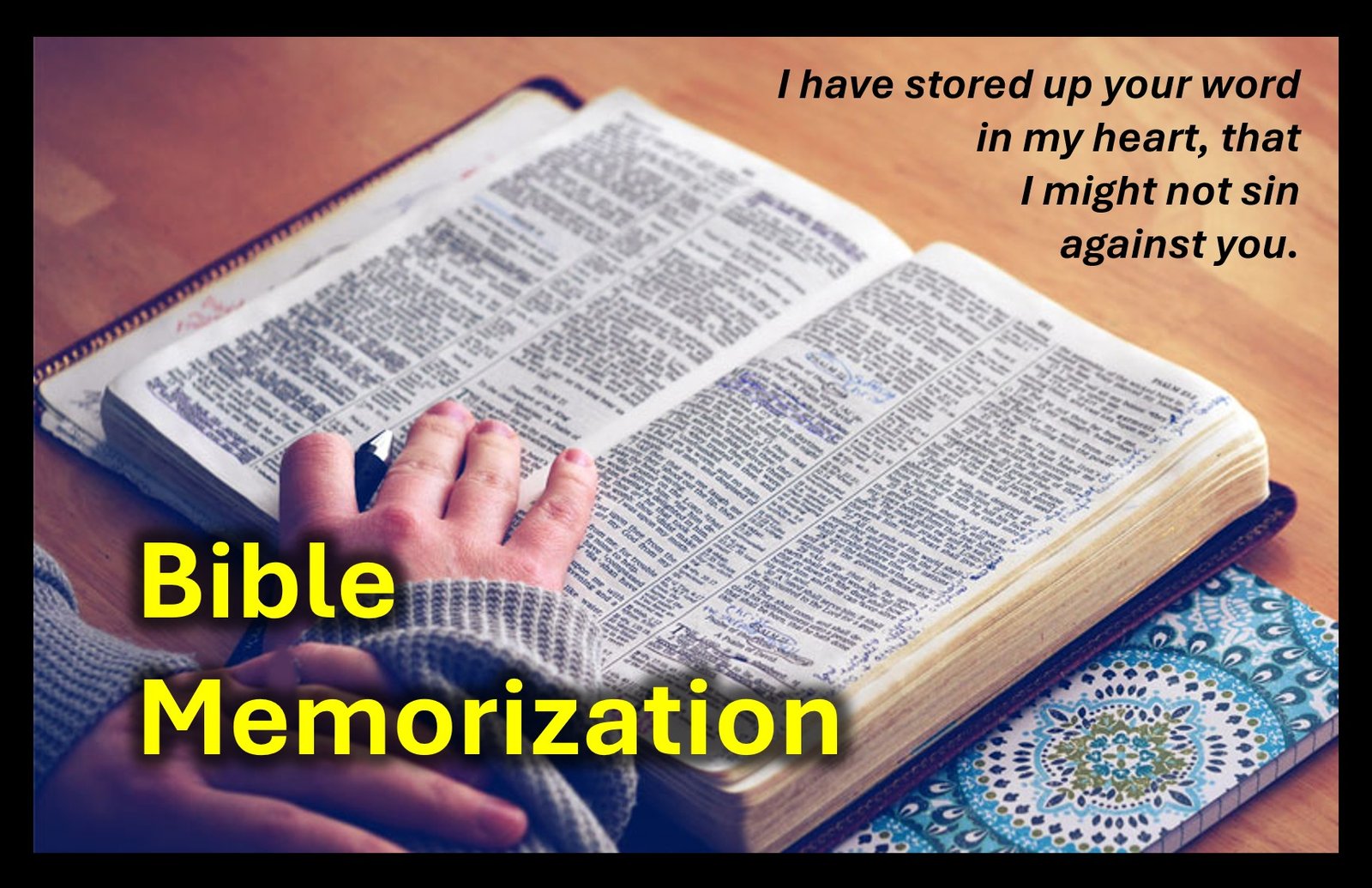
When you memorize God’s written word, it will stay with you the rest of your life.
The Holy Spirit will bring these verses back to your memory throughout your days, when needed most.
Memorizing Bible verses is one of the most important and effective activities of life for personal spiritual growth, for development of character, for strengthening faith, and for ministering to other people. Of course, you will only get out of it what you put into it. However, spending even ten minutes memorizing one Bible verse will make it that much more familiar and it may stay your memory the rest of your life.
Why Memorize Bible portions?
Here are some Bible reasons to memorize verses. (Also, good to memorize.)
- Storing God’s word helps us not to sin. Psalm 119:11
- God’s word is a light to our path. Psalm 119:105
- Blessed is the person who meditates day and night on God’s word. Psalm 1:1-3
- God’s commands make us wiser. Psalm 119:98
- God’s word helps us do what is right and prosper. Joshua 1:8-9
- God’s word succeeds in His purpose. Isaiah 55:11
- God’s word is profitable for correction and instruction. 2 Timothy 3:16-17
- God’s word discerns thoughts and intentions. Hebrews 4:12
- The Bible is from God. 2 Peter 1:20-21
Advice / Instruction to Learn & Study God’s Word
- Study or do your best to present yourself to God as one approved. 2 Timothy 2:15
- Teach them diligently to children. Deuteronomy 11:19
- Fear of God vs. fools. Proverbs 1:7
- Seek wisdom from God. Proverbs 2:1-5
- Wisdom comes from God. Proverbs 2:6
- Bereans were commended for searching the Scriptures to verify what they heard. Acts 17:11
- Let the word dwell in you richly. Colossians 3:16
- Abiding in Christ & allowing His word to abide in us is prerequisite to accomplishing His purpose. John 15:7
Why should we be familiar with the Old Testament?
The New Testament has no meaning without the Old Testament context. Memorizing the entire Old Testament will take a long time. However, there are key verses that help us develop a foundational framework for understanding the New Testament.
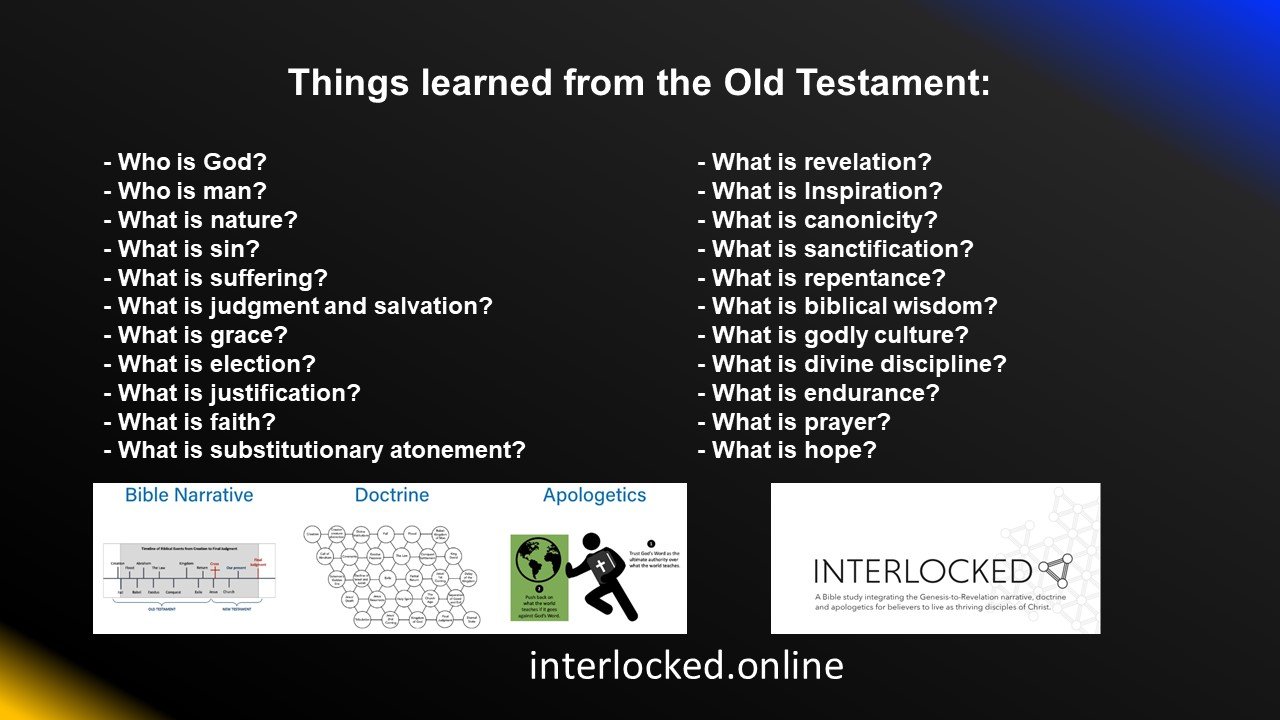
Things we learn from the Old Testament include God’s character, God’s purpose, God’s original design, the origin of everything, the design of people, the origin of gender, marriage, sin, and God’s promise of redemption. See, Things Learned from the Old Testament.
What are good foundational Bible verses to memorize?
- God made and owns everything. (God has the right to set the rules.) Genesis 1:1 (Colossians 1:16, Psalms 24:1)
- God made everything by simply speaking. (God has all power.) Genesis 1:3 (Psalms 33:9)
- On the fourth day God created the sun, moon, and stars. (Defeats the idea of evolution.) Genesis 1:16
- God created people in His image, giving greater value to people, with only two genders. (Shows the unique value of human life, gender, and marriage.) Genesis 1:27
- God gave people His purpose: to be fruitful, multiply, fill the earth and rule over it. (Purpose, marriage, sex, and dominion under God.) Genesis 1:28
- Everything God created was very good with no room for improvement. (God’s design was very good.) Genesis 1:31
- Life was given personally to people by God’s breath. (Designed for intimate personal interaction with our Creator.) Genesis 2:7
- In the Garden of Eden, God gave people only one command to believe and obey. (Love gives a choice.) Genesis 2:15-17
- God promised a redeemer, the seed of the woman, who would crush the head of the serpent who deceived her. (God’s plan for ultimate resolution was implemented at the beginning.) Genesis 3:15
- God clothed Adam and Eve with animal skins; their covering. (First shedding of blood as a substitute.) Genesis 3:21
- God was pleased with Abel’s sacrifice. (God is please with faith.) Genesis 4:4
- God reached out to Cain in his disobedience. (God reaches out even to those who treat Him as a liar.) Genesis 4:7
- Enoch walked with God and God took him. (God’s persistent desire for personal relationship through the response of faith.) Genesis 5:24
- Noah found grace/favor in God’s eyes. (Even in judgment God provides mercy and grace.) Genesis 6:8
- Before the global flood, Noah’s family entered the ark and God shut the door. (There is an end to grace and God’s justice is final.) Genesis 7:15-16
- People did not follow God’s design, so He destroyed them in a global flood, saving only Noah’s family. (There are dire consequences to not following God’s design by faith in His word.) Genesis 7:23
- God’s purpose is repeated to Noah to be fruitful, multiply, and fill the earth. (God still wants to fill the earth with people who believe Him.) Genesis 9:1
- God changed one language into many and God scattered people all over the earth. (God graciously dispersed pooled evil.) Genesis 11:9
- God promised to bless all families of the earth through Abram. (The Abrahamic Covenant) Genesis 12:1-3
- While Abram had no children, God promised specific land and millions of children. Genesis 13:15-16
Assurance of Salvation
Being sure of your eternal destination comes from understanding and believing that God is the one who saves people from His wrath, not ourselves. He will only forgive people on the basis of the sacrifice of Jesus Christ. For all who will believe Him, the eternal justice that was due to us was completely satisfied by Jesus Christ on the cross. When we realize that we are clothed in the righteousness of Jesus Christ, by faith, by believing what He said, we can rest in the gift that He has given us through His death, burial, and resurrection. Being clothed in the gift of God’s own righteousness is more than enough to cover all of my sin in the past, present, and future. It is the gift of Jesus Christ’s own perfect goodness that makes me acceptable forever in the presence of the Holy God. Below are some verses quoting God’s promises to all who will believe Him. Be sure to check on the context in which they were written. They are about being born into the family of God, not about how you live as a clean or dirty family member. These are great verses to commit to memory so that you can believe what is true and share these words with other people.
- Ephesians 2:8-9 People are saved by God’s grace, not what they do.
- Romans 6:23 The pay for sin is death, but God saves by His gift.
- John 10:27-29 No one is able to take away God’s sheep.
- Colossians 1:13-14 Delivered, transferred, redeemed, forgiven.
- Colossians 2:13 Made alive and forgiven.
- John 1:12 Receive and believe.
- Romans 8:15 From slavery and fear to adoption as sons.
- 1 John 3:1 Children of God.
- Hebrews 13:5b He will never leave you or forsake you.
- 2 Corinthians 5:17 In Christ, a new creation.
- 1 John 5:11-13 Written that you may know that you eternal life.
- John 5:24 Whoever hears and believes, has passed from death to eternal life.
- John 3:18 Whoever believes in Him is not condemned.
- John 3:36 Whoevery believes has eternal life.
You might
Bible memorization in American history… https://www.facebook.com/share/v/184LxmmhMp/?mibextid=wwXIfr
Memorization Methods
To memorize scripture there is really no way around putting in the time, effort, and discipline of repetition that is required.
However, a variety of methods can help you retain what you have learned in your memory until it is extremely familiar and easy to recall.
Here are some ideas to help you make verses sticky in your memory:
- Listen. Record your Bible verse on audio and play it on repeat. You can record it on your phone via voice memo, use an app like Speechify or Edge browser Read Aloud. You can listen to the YouVersion Bible, Bible Gateway, or a similar Bible app. You might listend to your verses while driving, walking, working, cooking, or sleeping. Listen, ask questions, define choices.
- OIA – Observe, Interpret, Apply. Observe everything you can about the verse by asking questions. Who wrote the book. To whom was it written? When was it written? Why was it written? What are the consequences? What will change? Who will change? When? Why? How? What attributes apply? Is this a complete thought or part of a bigger thought or command? Interpret. What is the meaning, purpose, and intent? Apply. How does this verse apply to me or the people in world around me? How does this verse change the way that I should believe, think, and act? (Howard Hendricks – How to Study the Bible?)
- PQRST. Preview. Question. Read Study. Test.
Preview the verse. Question. Read. What does the verse actually say? Study. Who wrote it? When? Who was it written to? Why? What is the context in time, the chapter, the book, history, Old Testament, New Testament? What does it say? What does in not say? What does it mean? How can I apply it? What are the actions? What are the results? Test. Can you consistently quote the verse word for word to yourself or other people while accurately communicating the meaning and effectual purpose? (Nursing PQRST)(PQRST Study Skills) - Word counting. How many words are there in this entire verse? How many nouns, verbs, objects, subjects, pronouns, verbs, and adjectives? If you know that the word “the” appears three times, then it is easier to remember when you missed one. How many characters are there? What action occurred? What are the objects? (In Genesis 1:1, the word “the” appears three times. The time was “in the beginning.” There was a beginning. God was there in the beginning. Nobody else. God created. The two ojbects of the word created are “the heavens and the earth.”)
- Meditation. If God was there in the begining, who else was there in the beginning? Was God alone? What did God create? What kind of power would it take to create the heavens and the earth? Why did God distinguish the heavens from the earth? What kind of person is God who could create everything we see and know in both the heavens and the earth? What does God’s creation of the beauty of the heavens and earth say about God’s ability to design, His purpose in design, His wisdom, diversity, and love? Why can we see variations in color, movements of bodies, intricacy in design? What are the implications of this verse on my daily life and my understanding of the Bible. (For more about Bible meditation, see J.I. Packer’s book, “Knowing God.”
- Silly Story. Are you having trouble getting the word order straight? Make up a temporary silly story using the first letter of each word. (John 3:16)(FGsltwthghoStwbihsnpbhel.) Use word and story associations to help you remember the main thing, the Bible verse.
- Opposite world. If the instructions of the verse were the opposite of what this Bible verse is telling you, what would that look like? Tell yourself what the verse does NOT say. Then quote to yourself what it DOES say, exactly. The idea is to reinforce the message in your mind of what God is communicating to you.
Memorization Tools or Apps (a youtube review)
- Bible Memory App – Free or Pro $10/year – Features
- This app has recommended memory verses by topic.
- Remember Me. Bible Memory Joy. (Cross-Platform: Web, iPhone, Google, APK)
Bible Verse Memory by Potter Solutions – hangman style game – KJV - MemLok Bible Memory System App – Free or $30
- Learn Scripture – learnscripture.net (Web)
- Scripture Box
- VerseLocker App at scripturememory.com
- Fighter Verses – free with paid upgrades – App at fighterverses.com – web
- Versify App at getversify.web.app
- Verses App – free/$5/$10/year – listentoverses.com